
Breaking Through in the Central U.S.: Media Strategies That Move 2026 Voters
July 13, 2026
For a country that can't seem to agree on what to watch, where to eat, or what belongs on a hot dog, Americans are remarkably consistent about one thing: showing up.
The election year is intensifying across the Central United States, and reaching voters in real life remains one of the most effective ways to break through. From high-dollar statewide races to hyper-local initiatives, campaigns face a shared challenge: reaching voters at scale while staying relevant within the communities they’re trying to influence.
IRL media plays a critical role in that balance. Sixty-eight percent of adults have recently seen an IRL political ad, and 56% of likely voters say they trust these ads to be truthful and accurate - reinforcing IRL as one of the most credible environments for political messaging (SOURCE: The Harris Poll/OAAA). When paired with mobile retargeting, that visibility extends beyond the roadway, following voters throughout their daily routines and reinforcing messaging across multiple touchpoints. With so many key races from state to state, here’s how the IRL media’s power to move people to the polls plays out in key races.
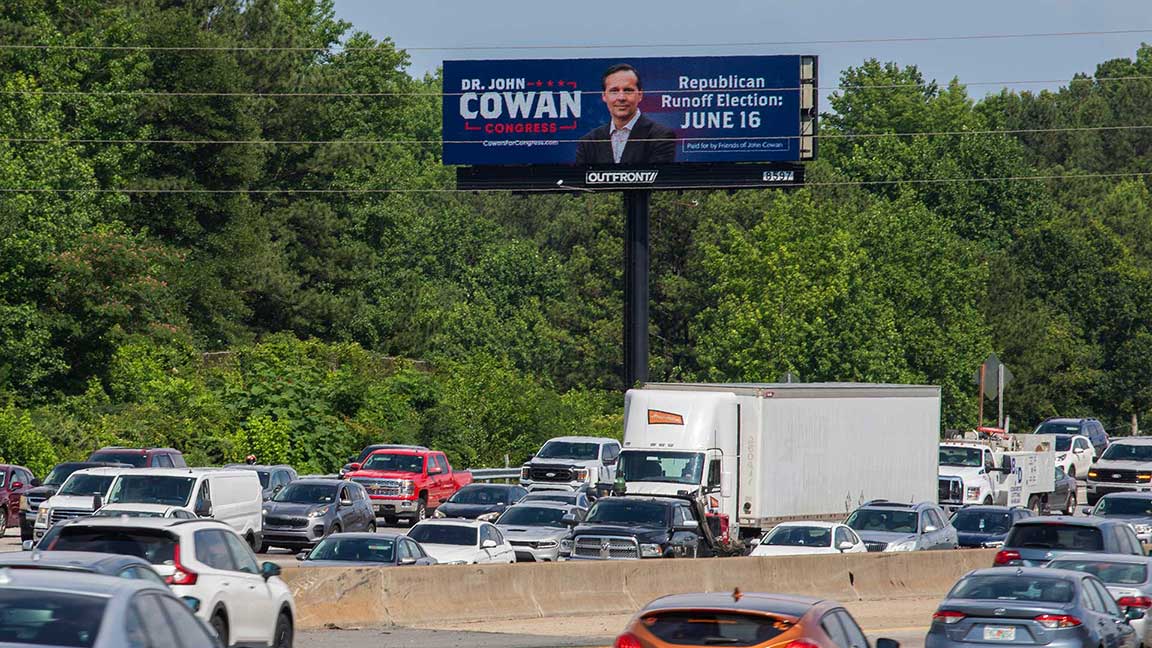
In Texas, a High-Stakes Statewide Showdown
Texas is shaping up to be one of the most competitive and high-dollar states in the 2026 cycle. With more than 17 million registered voters within the state, campaigns are tasked with building visibility across one of the largest and most diverse electorates in the country (SOURCE: Texas Secretary of State).
This cycle, that challenge is amplified. Governor Greg Abbott (R) is running for reelection, while the U.S. Senate race between Ken Paxton (R) and James Talarico (D) is expected to be one of the most expensive in the nation. With both races commanding attention at the same time, campaigns aren’t just competing for votes, they’re competing for share of voice across urban centers and rural communities.
That means showing up everywhere Texans are already moving. From I-10 through Houston to I-35 connecting Dallas, Austin, and San Antonio, bulletins play a critical role in delivering consistent, high-impact visibility across the long commute patterns that define Texas. In key markets like San Antonio, where Hispanic voters represent a critical share of the electorate, tailoring messaging to reflect local culture and language is essential.
In a state this large, success depends on more than reach. Repetition is key. Frequency and saturation build recall across a fragmented statewide electorate, ensuring campaigns remain top of mind throughout the cycle.
In Louisiana, Constitutional Amendments Call for Localized Strategy
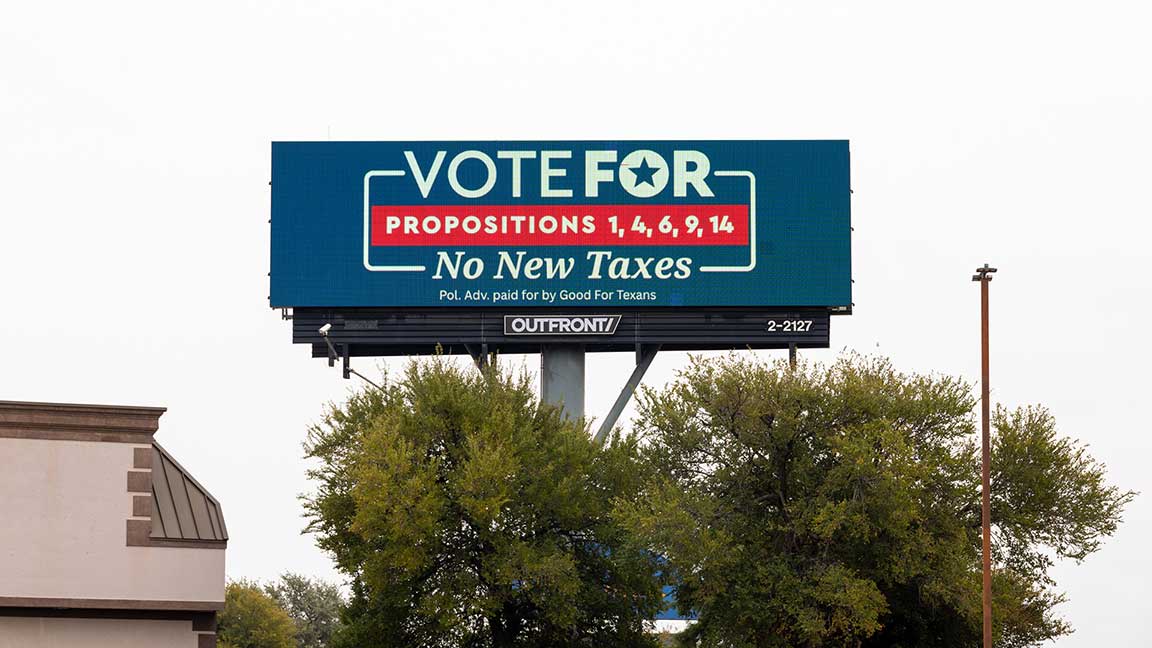
With more than a dozen constitutional amendments on the ballot spanning issues like property taxes, education, and criminal justice, Louisiana voters are navigating a crowded decision-making environment. The opportunity lies in simplifying messaging while maintaining local relevance.
Unlike candidate-driven races, these amendments don’t always come with built-in awareness. Voters in places like Baton Rouge, New Orleans, and other smaller parishes are being asked to weigh multiple issues at once, often without a clear understanding of how each one directly impacts their day-to-day lives.
That’s where localized IRL media becomes critical. Posters and bulletins positioned directly within neighborhoods help translate complex issues into clear, repeatable messages, meeting voters where they live and make daily decisions.
But awareness alone isn’t enough, especially when voters are being asked to process multiple issues at once. Extending that messaging beyond IRL media helps reinforce and clarify what voters are seeing. Mobile and CTV/OTT retargeting allows campaigns to build on initial exposure, providing additional context and repetition across different environments.
This layered approach is important because IRL advertising generates voter interest in further researching candidates and ballot issues, helping move audiences from awareness into deeper consideration. For those on either side of Louisiana’s amendment battles, being seen isn’t enough. It’s about being understood.
In Michigan, Thin Margins Decide the Outcomes
Michigan remains a true battleground, with national attention firmly focused on the state. Here, election outcomes are often determined by thin margins across shifting voter blocs, meaning that even small shifts in turnout can tip the balance.
This level of media noise creates a real challenge. Local messaging is up against a constant stream of national superPAC money that can overshadow even the most targeted efforts. In this environment, success depends on reaching the right voters in the right moments, with messaging that cuts through the clutter.
A layered IRL media strategy allows campaigns to establish both scale and precision across the state. Bulletins dominate commuter routes into Detroit and along major corridors through Grand Rapids and Flint, while posters across the state build consistent visibility in the neighborhoods where persuasion and turnout happen.
Additionally, wallscapes work great for areas with high commuter density and concentration of high-income professionals. These are some of our largest IRL media canvases, allowing for an unmissable larger-than-life presence that can be seen from blocks away by both pedestrians and motorists.
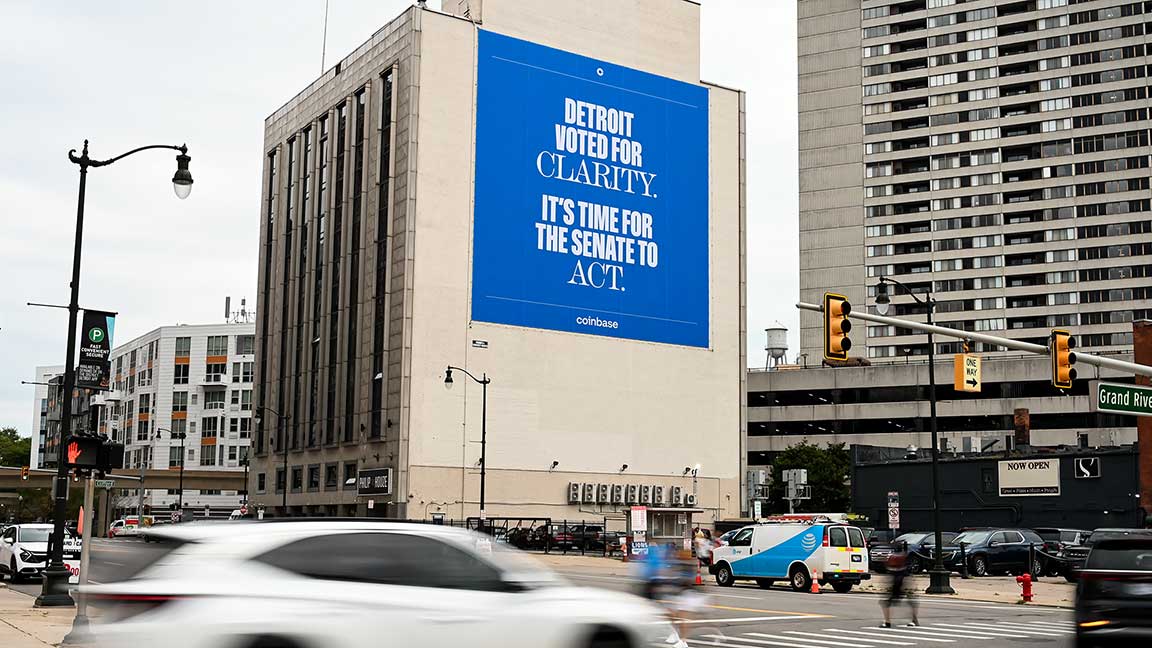
Take this Detroit wallscape from Coinbase. Its messaging was lobbying for crypto legislation. Backed by the exchange’s political action committees and grassroots voters, the campaign successfully lobbied hundreds of candidates to clarify their stances on digital asset policies ahead of congressional elections.
In a state where margins are tight and momentum can shift quickly; a large presence is critical. Maintaining your visibility across the state allows your messaging to work hard by reaching voters on their daily journeys.
In Memphis, A High-Profile Showdown in the Democratic Primary
In Memphis, ten-term incumbent Steve Cohen faces a high-profile challenge from Justin Pearson in one of the country’s most visible Democratic primaries. As one of the nationally recognized “Tennessee Three,” a group of lawmakers who drew national attention after leading a high-profile protest at the state capitol in 2023, Pearson brings added visibility and intensity to the race.
Although hyper-local, this race draws national visibility. Pearson’s elevated attention means voters are more aware, but also more saturated with messaging.
The race is emblematic of the current trends that include older, more experienced incumbents fending off younger, activism-driven candidates. For candidates in a district like Tennessee’s 9th, coverage is about density. Bulletins across key corridors create a visible, consistent presence. To maximize impact, campaigns should consider pairing them with mobile retargeting, allowing messaging directly on voters’ devices to link IRL and URL.
A mobile layer allows campaigns to layer in hypertargeting based on past turnout, voting behavior, early voting patterns, or location within the district. In a primary where turnout is everything, precision and repetition move voters to action.
The influence of IRL media is particularly strong among younger voters, with Gen Z and Millennials significantly more likely than older audiences to say IRL political ads impact their decision-making (SOURCE: The Harris Poll/OAAA).
Whether voters in Memphis lean towards a more tenured candidate, or a more grassroots candidate, IRL media gives campaigns the power to move voters to the polls.
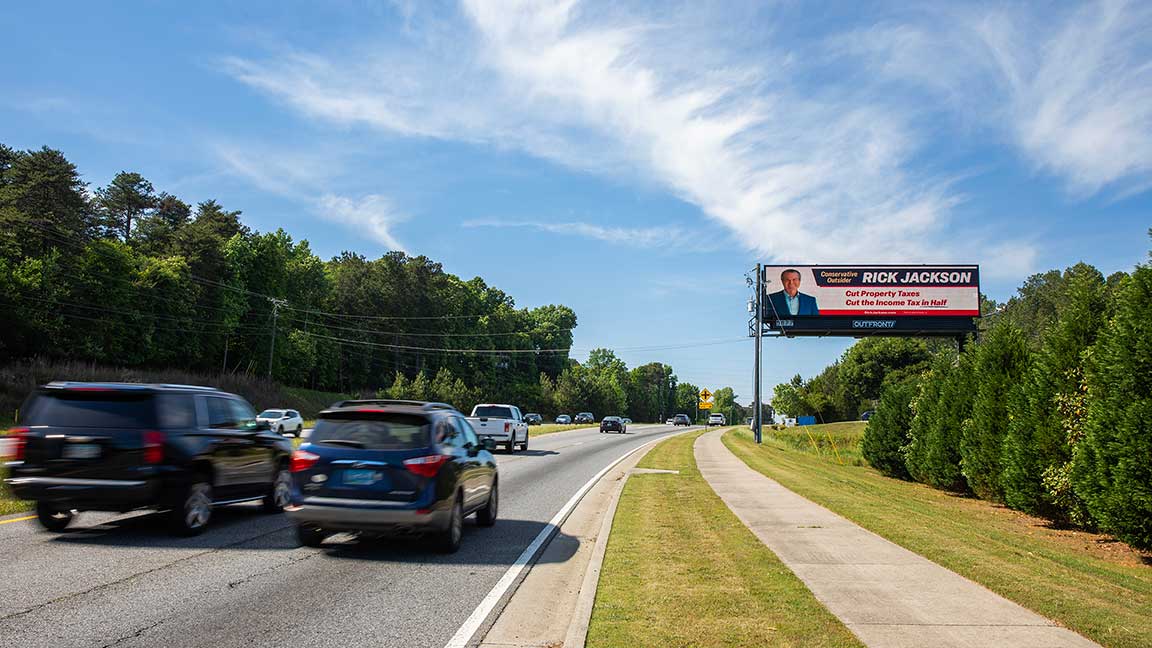
Georgia’s Governor’s Race Is a High-Dollar Power Play
Georgia’s governor’s race is emerging as one of the most closely watched contests in the South, with more than 7 million registered voters3 spread across a state that continues to evolve (SOURCE: Georgia Secretary of State).
Republican nominee Rick Jackson, a billionaire outsider, secured the nomination after defeating Trump-backed Lt. Gov. Burt Jones in a June runoff powered by more than $100 million in self-funding. On the Democratic side, Keisha Lance Bottoms emerged from a crowded primary field with 56.2% of the vote, positioning Democrats for a competitive bid to reclaim the governor’s office for the first time in over two decades.
With two well-known candidates and attention building, the winning campaign must reach a diverse electorate that spans Atlanta’s urban core and more conservative rural regions across the state.
To meet this moment, campaigns are combining bulletins and programmatic DOOH to achieve scale with flexibility. Digital bulletins across Georgia’s most trafficked corridors deliver high-impact visibility, while programmatic capabilities allow campaigns to optimize messaging in real time, whether by adjusting creative, refining targeting, or shifting delivery based on audience behavior, geography, and timing.
This level of adaptability gives campaigns a critical advantage. As voter sentiment advances throughout the cycle, messaging can evolve with it, ensuring continued relevance across Atlanta, Columbus, and key routes like I-75. In a race defined by investment and scale, digital precision and real-time optimization will be key to breaking through.
Illinois Elections: Competition at the Top of the Ticket
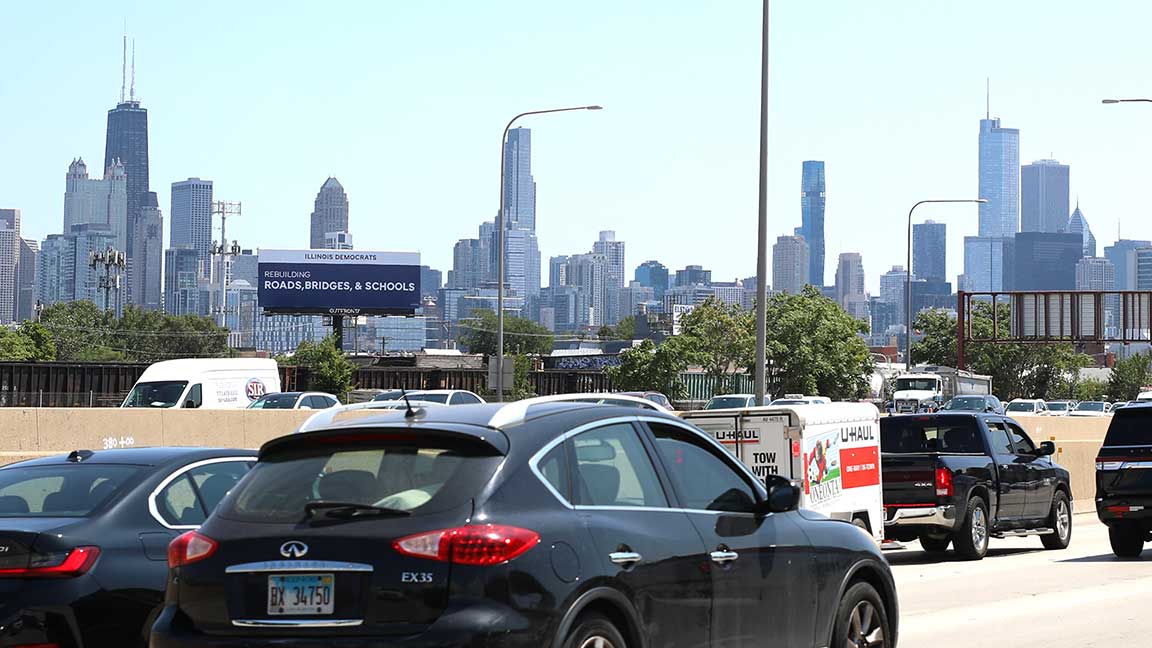
In Illinois, Governor J.B. Pritzker is running for reelection in a race expected to draw significant investment as he explores a potential 2028 Presidential bid. Increased spending at the top of the ticket will elevate competition statewide, as campaigns work to build and sustain visibility.
And the open U.S. Senate race between Juliana Stratton and Don Tracy introduces an added layer of strategy, with both campaigns focused on testing messaging and expanding statewide recognition.
Tapping into a IRL media mix that includes wallscapes, bulletins, and posters might be a great solution. Walls work well in high-density commuter corridors and urban centers. As one of the largest real-world advertising formats, they deliver an impossible-to-ignore, larger-than-life presence that commands pedestrian and vehicular attention. Bulletins reach audiences in heavily trafficked highways and arterials, targeting both commuters, who pass the signs daily, and long-distance travelers. Posters are especially prominent along primary and secondary roads in commercial and industrial neighborhoods, which makes posters perfect for targeting local audiences.
In a cycle where investment is expected to increase, the ability to sustain visibility across formats and geographies will define which campaigns break through.
What it Takes to Win in 2026
Ultimately, across every race, the challenge is the same. Campaigns need to break through in crowded, high-stakes environments where attention is limited and competition is constant.
What remains consistent is the need to meet voters where they already are. IRL media places campaigns directly into those moments, whether that is on major roadways, within neighborhoods, or as part of daily routines. From there, connected extensions reinforce that presence, helping campaigns stay visible and relevant throughout the entire voter journey. With more than half of voters describing IRL political ads as influential and informative, campaigns that invest in consistent, real-world visibility are better positioned to build trust, drive recall, and ultimately move voters.
In a cycle defined by scale, complexity, and rising investment, the campaigns that stand out will not simply be the ones spending the most. They will be the ones that maintain consistent visibility, speak to local audiences in meaningful ways, and show up in the environments where voters are most engaged.
Contact OUTFRONT today to get your message in front of voters where it counts most: in real life.
Author: Lauren Graff and Sally Peay, Marketing Specialists @ OUTFRONT
Links to third-party content are not endorsed by OUTFRONT Media. Past performance may not be indicative of future results. OUTFRONT does not guarantee specific results or outcomes.
Relevant OOH Content Straight To Your Inbox
Essential out of home insights, trends, and success stories. Delivered weekly.
Related Stories
See More Stories
How IRL Media Wins the West: The Power to Move the 2026 Election

What Political Media Buyers Need to Know About Election 2026
2024 Election Advertising Trends: Here’s What’s Happening with Out of Home

Why Advertising in Real Life with OOH is the Ultimate D.C. Power Move