
The Brands Filling in the Blank: You Can’t AI ____
August 26th, 2026
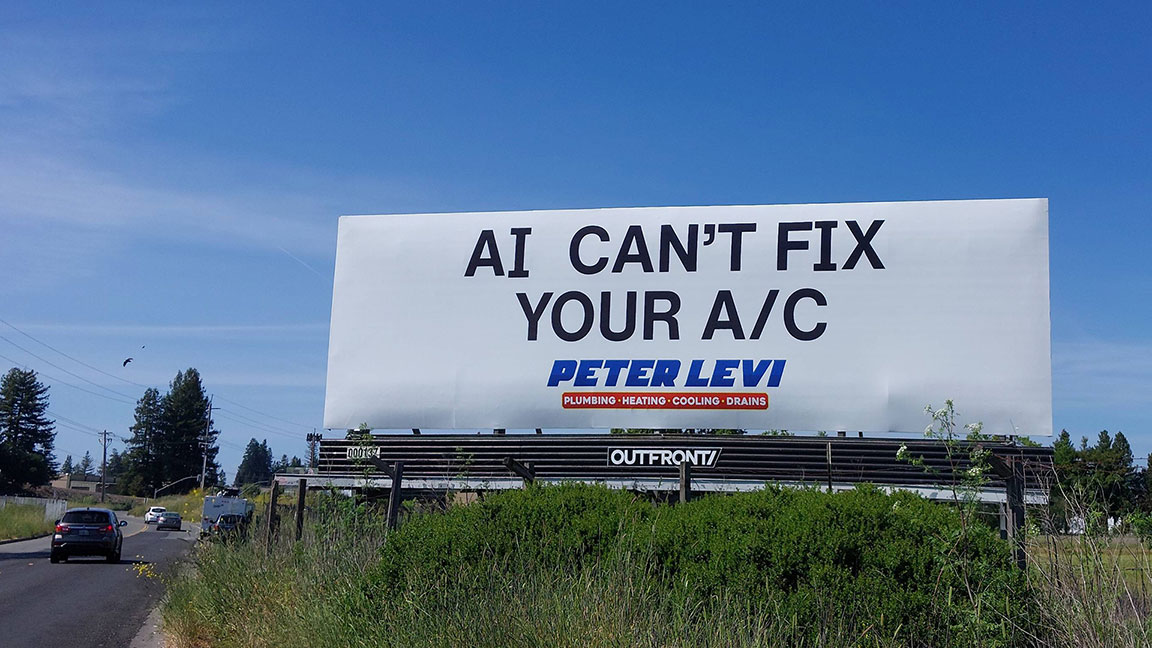
I saw a billboard recently that I’ve thought about more than I expected to. It was an OUTFRONT billboard for Peter Levi Plumbing, Heating, Cooling & Drains, and the message was very simple: “AI can’t fix your A/C.” It made me laugh, but it also made me think they were onto something. Then I saw another OUTFRONT billboard from Hurlburt Heating, AC, Plumbing & Electrical with its own version: “AI can’t fix your furnace. But we can.” At that point, it felt less like one funny billboard and more like a creative pattern worth watching.
We’ve been talking lately about the idea that You Can’t AI IRL. The web is becoming more automated, and more of what people see online is being shaped by bots, AI tools, and algorithms. Bots including agentic AI account for 57% of web requests globally, compared with only 43% from humans (SOURCE: Cloudflare). That does not mean people have disappeared from the internet, obviously, but it does show how much of the digital world is now being navigated by machines. So showing up in the real world, in front of real people, starts to feel less like a media talking point and more like the actual point.
This is happening alongside some real pushback against how much of everyday life now feels automated. It is not necessarily anti-AI. It feels more like fatigue with always-on technology and a wariness about what is real online. In new OUTFRONT research with Kantar, 35% of respondents said it is getting harder to tell what is real and what is not, while 52% said they have paid more attention to storefronts, signs, and advertising around them in public. People may not be rejecting AI altogether. They may just want some balance.
What I liked about the A/C example is how specific it was. It took a huge, messy conversation about AI and made it very practical. You can’t AI an A/C repair. You can’t AI a plumber showing up at your door. You can’t AI someone fixing your heat when it goes out at the worst possible time. For a local business, that physical presence is not just the service. It is the promise: an actual person is going to show up, solve a real problem, and be accountable in the community they serve.
A lot of the AI conversation has been about what it can replace, what it can speed up, or what it can generate. But there is another side of the conversation that feels more interesting to me: AI is also making certain real-world businesses look even more valuable.
Think about HVAC, plumbing, electrical, roofing, auto repair, pest control, and other home services. These businesses do not have to work that hard to explain why they matter. When something breaks, no one is looking for a polished chatbot answer. They need an actual person who knows what they’re doing to come fix the problem. The challenge is that every competitor can make that same promise. Advertising is what turns an obvious category benefit into a familiar name people remember before the emergency happens.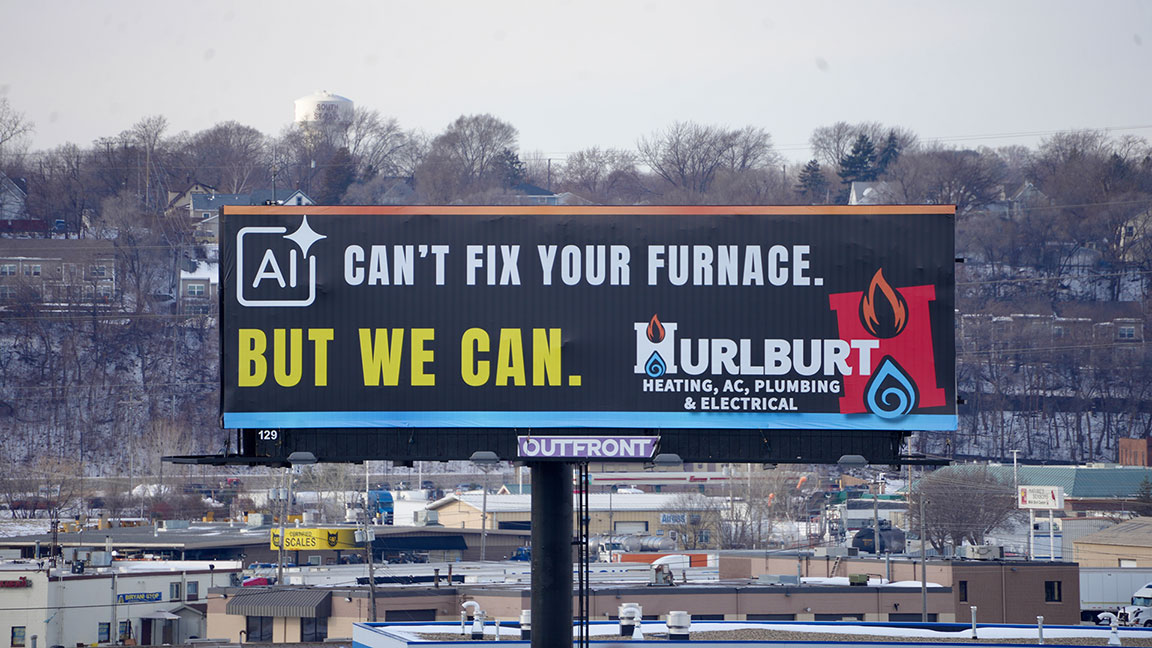
That is why the “AI can’t do what we do” message works. It does not feel like a brand forcing itself into the AI conversation just because everyone else is there. It works because the point is easy to understand, and the humor comes from how true it is. AI can help write the ad. It can’t install the unit. It can explain why your sink might be leaking, but it can’t show up with the right part. AI might be able to tell you why your sink is leaking, but if its advice leaves your kitchen flooded, an apology from a chatbot is not going to fix it.
Seeing that message on a billboard makes the point land even better because the medium reinforces the message. It is a real-world message for a real-world service, seen by people while they are commuting, running errands, and dealing with life in real time. The brand is physically present in the same community where it is asking for people’s trust.
For marketers, that is the bigger opportunity. Not every brand needs to make an AI joke, and I hope they do not. But every brand should probably be asking some version of this question: what do we do that AI can’t?
And the strategy is not limited to home services. Polaroid has been leaning into digital fatigue with lines like “You can’t bask in blue light” and “Go jump in some water before the data centers drink it all up.” See’s Candies had its own version: “You can’t AI this,” with nothing more than its logo and some chocolate. The products are completely different, but the strategy is related: identify what your brand makes possible in the physical world, then use IRL media to make that contrast impossible to miss.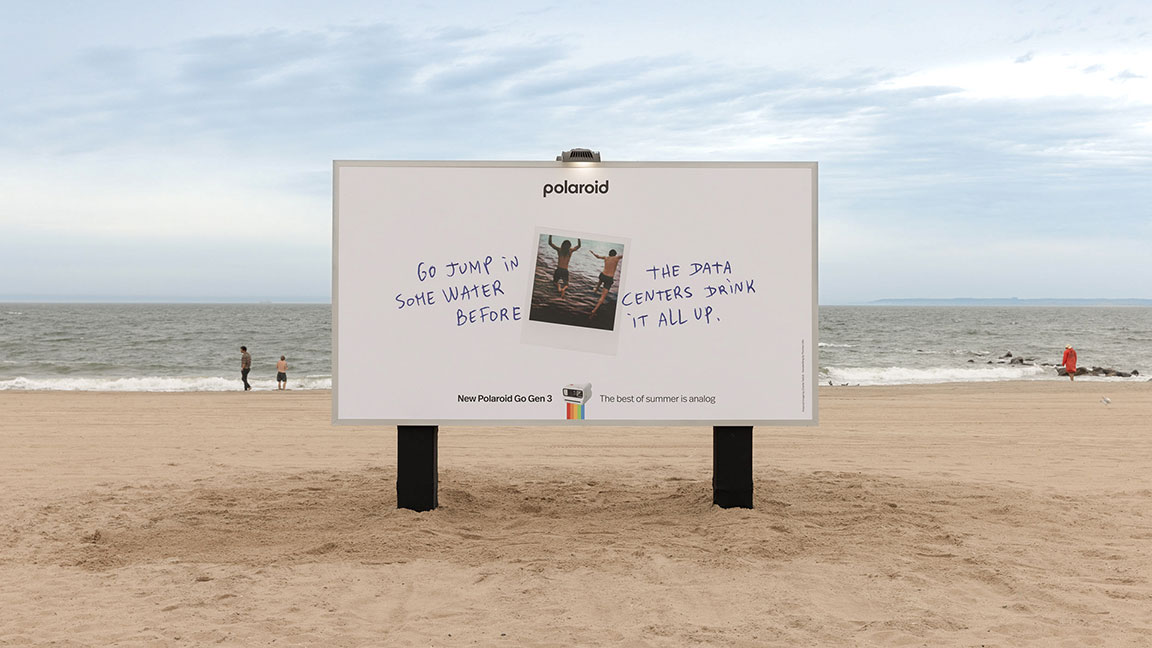
For a home services brand, the answer is pretty direct. They show up. They fix things. They build trust locally because people see their trucks, their teams, their reviews, and their name around the neighborhood. That kind of familiarity matters when someone finally needs help. In the same OUTFRONT/Kantar research, 79% of respondents said advertising they can see in person is more believable than advertising they only see on a screen. For a category that asks someone to let a service provider into their home, trust is not a soft brand metric. It is a critical part of the decision.
That is also why IRL media makes sense for this category. Out of home has always been good at making a brand feel established. It gives a business a presence in the places people already know and in the community it actually serves. For local and regional service brands especially, that presence can do a lot of work before someone ever searches: building familiarity, legitimacy, and the sense that this company will still be there when you need it.
The AI conversation gives these brands a fresh way to say something that has probably always been true: we do real work, for real people, in the real world.
I do not think “You can’t AI this” needs to become a line everyone copies until we’re all tired of it. But I do think the idea behind it is smart. As more of digital life starts to feel automated, real-world presence is going to stand out in a different way.
So maybe the next interesting wave of AI-era creative is not just about what AI can do. Maybe it is about what your brand can do that AI can’t.
Because you can’t AI IRL.
And for brands built on actually showing up, that blank might be a very good place to start.
Let’s fill in the blanks together. Contact us today!
Author: Christine Rose, Senior Marketing Director, West Region @ OUTFRONT
Links to third-party content are not endorsed by OUTFRONT Media. Past performance may not be indicative of future results. OUTFRONT does not guarantee specific results or outcomes.


Relevant OOH Content Straight To Your Inbox
Purchasing the Zeitgeist – Why IRL Out of Home Advertising Is a Real Friend to AI Startups

Why the Rise of Artificial Intelligence Is Driving a Renaissance of the Real

Imagine If Brands and Their Audiences Could Co-Create Entire Worlds Together With GenAI

The Cryptic Billboard Era: Why Some Of Today’s Best Ads Make No Sense