
The Return to Real: Here’s What Industry Leaders Said About IRL in the Age of AI
October 1, 2026
The renaissance of real life is everywhere you look. It can be found in trends ranging from record-breaking vinyl album sales to tabletop mah jongg games. There’s a common thread that connects them all: a deeper sense of being present in our own lives.
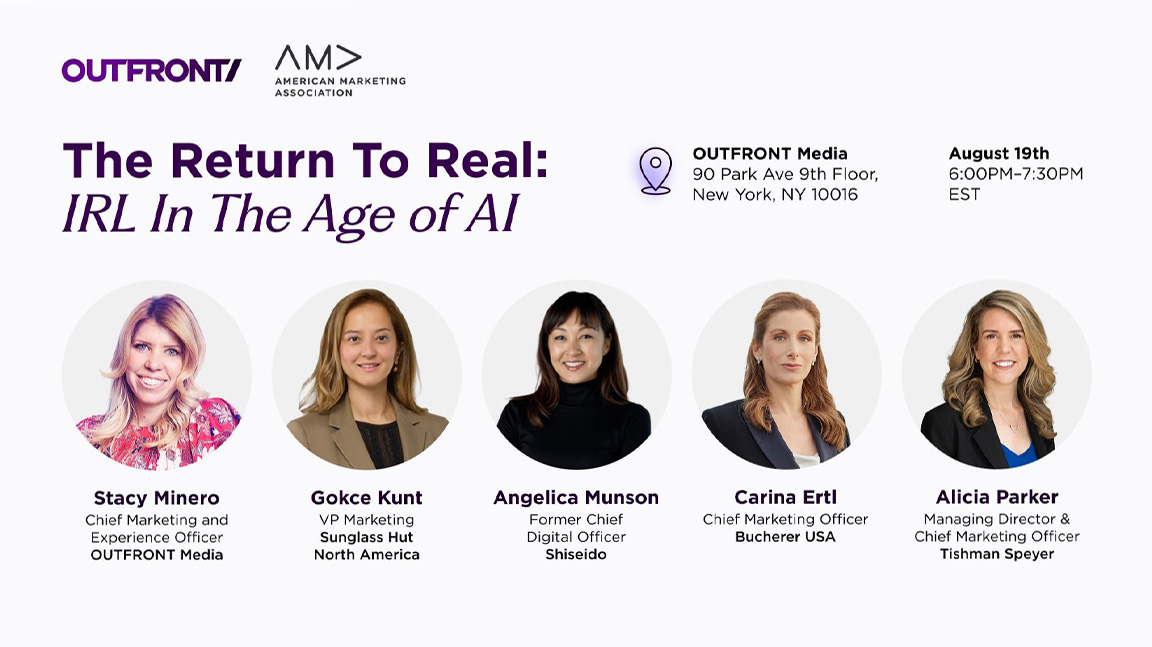
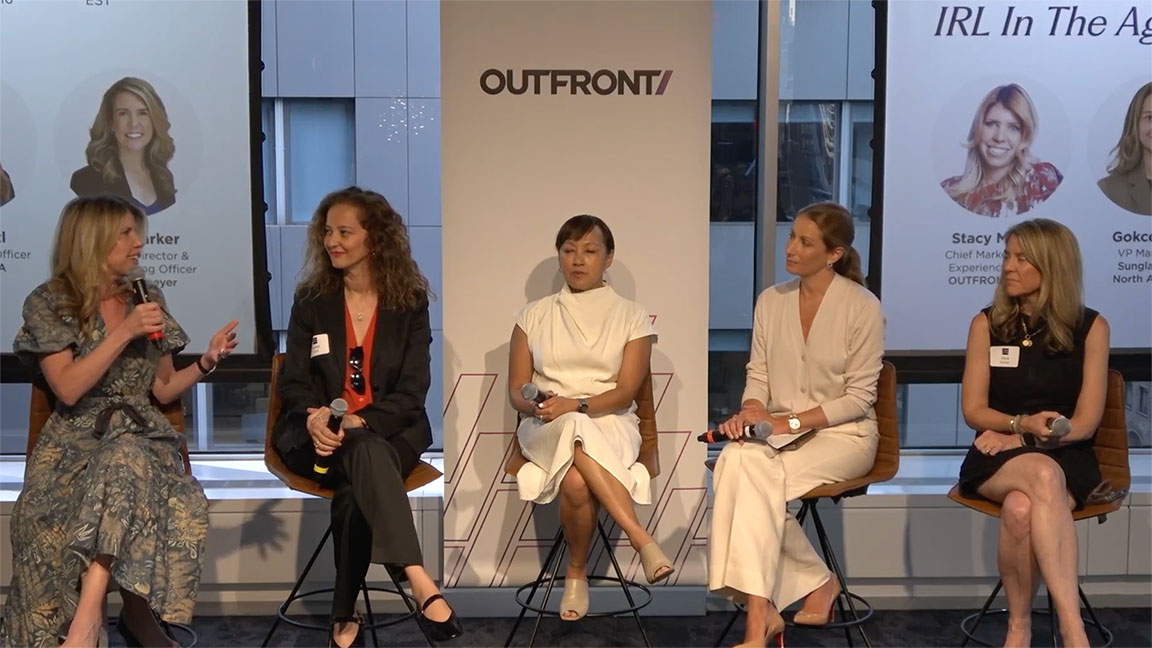
But what does that mean for brands? The American Marketing Association and OUTFRONT recently hosted The Return to Real: IRL in the Age of AI, gathering together industry-leading brand marketers for a round-table discussion moderated by Stacy Minero, our Chief Marketing and Experience Officer. Here are some of the highlights.
On brand experiences that resonate:
Angelica Munson, former Chief Digital Officer at Shiseido: There's a fragrance brand called She New, which is fantastic. When you walk into one of their shops, you're kind of in a jungle setting where all of the ingredients are laid out like a scientist table or an archeologist table. And the beauty associate, the fragrance associate walks you through the story of the notes and the alchemy of the product…it's hard to understand really scent or emotion, even if you go and get sprayed, you know, tester in the store. But this was just the utmost storytelling that I was dreaming about the store the night after I visited.
Alicia Parker, Managing Director and Chief Marketing Officer of Tishman Speyer: This summer, many of us experienced in a number of different ways the World Cup. At Rockefeller Center, we created a fan village, and so many people didn't have the opportunity to actually go out and experience live games. But what really struck me was that shared experience of people having that in real life. We turned the ice rink into a soccer pitch or a football pitch, Telemundo was broadcasting, and each match there were people from all around the world, and we had Lego that had built the largest mobile Lego FIFA trophy, and we had Bank of America, and people were lined up at 3:30 in the morning to get the fan bands, and we had Panini trading cards and the Hyundai Museum. In total, we had 17 brands.
But I think what struck me the most was after World Cup was over a week ago, I walked through Rockefeller Center and I saw a group of 40 people still trading Panini cards…that had all gone and none of that activation was there. But it was that in-person connection that they had built… They had felt connected enough that even after all of that was gone, to come back and to continue with that shared experience.
On designing workflows and unlocking potential in the age of AI
Gokce Kunt, VP Marketing, Sunglass Hut North America: There are four different phases [of the customer journey]. The first one is a market. Here we are driving to strengthen our brands in order to increase the awareness and in order to drive brand desire and consideration. This is the category users and the second phase. We want to convert them into visitor side. We want them in our stores and then with the perfect experience and operational excellence, operational excellence, we drive them into customer phase. And then the loyal customer phase.
AI of course, helps us with the repetitive tasks … There are millions of data that you cannot understand. With the help of AI, you get the best insight…by analyzing it, by understanding the main insights. With the time that you save from all this operational workload, you focus on where to optimize your experience, how you can build the emotional bonding, and how you can increase your loyalty, your retention rate.
Angelica Munson, former Chief Digital Officer, Shiseido: We started something called the Beauty Tech Lab and it wasn't AI versus human. It was how can we get consultants? Some of them had been working for various brands for sometimes 30 years, and they were used to a certain type of clientele ritual. But when we introduced a machine learning team, that was the operational layer. That team was able to create skin diagnostics that could then help capture not just the moment in time of somebody's skin, but could help them match with the right brands and the type of formulations that were right for them, and then create data that was more longitudinal.
And so the beauty about this marriage is that all of the input came from the beauty associates. A lot of the feedback they were getting, as that first level of communication with an empowered consumer, they were taking that data and they were feeding it back into the team. And that data was really one of the cornerstones of how do you improve the skin diagnostic tool.
And the other point is, ratings and reviews are an amazing way in which you could also input and extract what your consumers are saying about you, social listening. So a lot of it is not this versus that, but a marriage of both.
Carina Ertl, Chief Marketing Officer, Bucherer USA: I love the marriage of both. I think it's a healthy balance where especially in luxury, you want like invisible technology, you want to use all the stats, you want to use intelligence. But then outside it's still like about visible humanity.
So we want to create beautiful moments… the inspiration can be AI-driven. I can have like a whole data field, AI can optimize it by my customer segmentations, but then how I'm implementing it – that's where the differentiation comes in and that cannot be replaced. That's a human craft. How I implement the brand based on its authenticity, based on its core values, how I create these specific little moments.
That's a human skill set, that level of taste, creativity that cannot be replaced by AI. But it can be informed… All this can be intelligently informed in the background, invisibly.
Alicia: What we're seeing is AI is really raising the floor of what we can do and how we can do it…But as humans, we get to raise the ceiling. We get to sit in a room and think about how we're going to debate with each other of what we ought to do, what we're going to create, what that plan is going to be. The onus of that is really on us to start to say, okay, this is everything I can do faster, and how am I going to think about how I'm organizing my team to push ourselves even further?
On creating community with IRL experiences
Carina: We have a series where we talk about certified pre-owned watches, timepieces that you no longer can buy. It's like almost like a candy store for watch lovers. … we bring together community and we have a host. Usually the host talks about their passion for watches, but also their personal story. It's truly about being authentic. Your personal story, your personal story of success, and people just love being in that room. The feedback that we get is not, “Oh my God, I love this timepiece. Oh my God, I bought two timepieces.” It was like, “oh my God, I met so many great people tonight.”
They become loyal. And they come back and they create their own little WhatsApp or Facebook groups, and they go out to dinners together and they come back because they will be loyal to us forever, because we brought them together. And they come back to the next event and they bring their friends and they bring more friends. And it's very old school because it's a little bit like this word of mouth, but it's a really strong community. And at the end of the day, it drove significant sales.
Alicia: Going to music, we have Rough Trade records, and I think what's really interesting is to see the lines that form, and that becomes a shared experience, even just going to get the thing with someone or to buy the thing. You start to see brands really looking at people lining up to have that shared experience.
We really started to think of [Rockefeller Center] as a media channel in and of itself. … people are just looking to the core of what marketing has always been, and that is about eliciting an emotional experience and having somebody hold that to drive brand awareness, brand affinity, loyalty. … we now have more levers in crafting that experience in total, how we touch them. Maybe before they get there, what we do once they're there, what we do once they leave. But I think crafting that moment is something that does require that human commitment to what is going to happen every step of the way.
On the power of IRL sponsorships
Gokce: One of the things that we have done recently… evolve our loyalty club from the transactional platform to more committed platform. We are the sponsors of different organizations like New York Liberty or festivals like bottle Rocket. We invite our loyal customers to these events, and this replicates the human touch and emotional bonding …they were super excited to attend these events. And then we shared their experiences with the customer database. I think this is a great way to build the emotional bonding with your brand. … we should focus on what is in our hand and how we can utilize in different phases of the journey such kind of events.
On orchestrating creators as part of the brand story:
Angelica: There are several makeup companies that have such a loyal customer base, but they actually have very loyal makeup artist base … there are programs where [artists] become your first line of advocates who are there showcasing the products. They themselves have their own little black books, their clientele. So I think there's a lot of opportunity with that… where technology can come in and help is really target the right audiences for some of those influencers.
Alicia: Most recently we had when BTS was here for their concert. We partnered with them, and what I found really interesting about it was the experience we created with them didn't actually include BTS, they weren't able to be part of it, but the experience that we co-created with them, fans really wanted to come and tell that story of what they were doing in that curated experience…you can actually think about what that experience is going to be that is connected to that brand that you're partnering with, and create that in such a way where the content that they're actually creating from it is the shared experience.
On the future of brand marketing, at the intersection of human craft, creativity and technology
Angelica: The future of it is in the hands of this next generation. I think we're here because we knew and know technology and how we utilize it, but definitely with the creators, they're utilizing these tools, but they're longing for authenticity and they're longing for community.
Gokce: We need to understand all these data to analyze and to get the best insights…But on the other side…we need to focus on how we are going to improve our brand experience, how we are going to strengthen our emotional bonding in order to drive the loyalty. Because I think the biggest question for future will be the loyalty. How we can provide, how we can strengthen the loyalty, is the main question that we need to solve for in the upcoming years.
Carina: For us, the next three years will have a strong, strong focus on human connection, on creating incredible experiences, like really more being exclusive while also being efficient. Like using AI to help me create things, to help me optimize, to have this intelligence behind me. But like really focusing on the implementation and really focusing on community and creating cultural like relevance as well.
Alicia: My prediction is that we need and will evolve from this focus on attention and impressions to memories, and that we will figure out how to measure that, because I think more and more, when you look at what then comes back, the retelling of an experience that you had, what that creates, over time…when you continue to invest in brand at the same time, as looking at everything you're doing in the lower funnel, it works. And I think it's just something that many of us have seen.
When you make those decisions in challenging times and you pull back on that brand investment, it impacts you. We will continue to get more and more sophisticated to get to the point where we talk about it in the same way, where it gets comfortable with that, that last click. But I think the proof is there.
On the evolution from transactions to relationships:
Gokce: We need to have the transaction-related communication. And it should be personalized…but on the other side, connection is really important and it starts from the retail perspective. It starts in your stores because the real-life moment that you have and how you make them feel in the store, drives the loyalty. You need to integrate this human touch into your loyalty program as well.
The assumption [is that] the digital media online channel drives the attention and drives the sales for this product, but it is not the case. It is the human touch. A human needs human validation. Humans need the answers from the humans, from the experts.
On the importance of store employees in IRL brand experiences
Gokce: One of the key objectives that drives business is to drive traffic to our stores. So maximizing the visibility, increasing the emotional bonding, this will help us to drive the traffic to our stores. Of course, in line with these priorities, we invest heavily for training. … the turnover rate is super high in the retail business, and it is super expensive to train. And that is a major part. But that is our priority, to train.
Carina: This is the brand ambassador. This is the first interaction with the brand. So training is like absolutely crucial and very important… Ritz-Carlton has a vision or a value where they say, “We are ladies and gentlemen, serving ladies and gentlemen.” So when we do experiences for our store teams, we treat them like we would treat them our clients… we try to showcase how we treat the clients and treat the store teams at the same way.
Alicia: Now more than ever, you do have an ability actually to look at all of those touch points, to think about the connected experience, to think about what store employee was working when the sales went up. And you can get down to almost that granular level to start to see, was that a store that was trained? Was that a store that wasn't trained? When I worked at Peninsula [Hotels] and I did just training in general, anybody that comes through the door, I would say, “Welcome to the marketing team.”
Because whether you're a housekeeper, whether you're on the concierge team, whether you're at the front desk, they are all an extension of the marketing team. And I think that's really important to start with that employee experience, to treat employees like they are the customer, so that they continue to convey those brand values and that brand experience over and over again.
On validating the ROI of real-life brand experiences:
Angelica: Many of us are in performance marketing and it's always like, last-click attribution…But that's people already in that bottom funnel. It's important that we're always thinking about building brands, building equity…Obviously there's brand lift studies and NPS scores, but I think the more and more these experiences are really authentically part of the brand, you're going to get that love. Attribution, the way it goes now, is you're already in reality measuring where people are coming to your brand because they you have invested in that top of the funnel and those experiences.
Alicia: We look at it in a couple of different ways. We have multi-year, so we have a multi-year relationship with Visa, and they’re our payment partner at Top of the Rock. We also activated with them during the World Cup and created a Visa Infinite Lounge, which was a larger expression of the brand. We really start with what their business KPIs are and then how we're going to put in place measurement around that. It's really understanding from the beginning what they're looking to achieve. Is it that they want to build it into a press moment? Is it that we want to create media that drives that we can then count? You can build in activations around sign up and email capture. You just have to look at what that investment is, what the brand's individual KPIs are, and then build into it.
On what AI won’t replace, and where to use it:
Gokce: The foundation of marketing is understanding your customers…we should focus on what are our brand strengths and what is the expectation of our customer and what we didn't answer from the competitive environment… the fundamental of marketing is curiosity. You need to be curious. You need to be in the field and understand and absorb your customer expectation and needs in order to drive the brief correctly for your agencies or your stakeholders.
Stacy: Some of the best creative ideas stitch opposing ideas together. It's like the unexpected convergence of two things. I don't think AI can do that yet. It probably will. But I think it's like that alchemy around unexpected trends or insights that create some magical moment.
Is your brand ready to create its own magical moment? Contact OUTFRONT today!
Author: Jay Fenster, Sr. Manager, Marketing Content @ OUTFRONT
Links to third-party content are not endorsed by OUTFRONT Media. Past performance may not be indicative of future results. OUTFRONT does not guarantee specific results or outcomes.
Relevant OOH Content Straight To Your Inbox
Essential out of home insights, trends, and success stories. Delivered weekly.


